





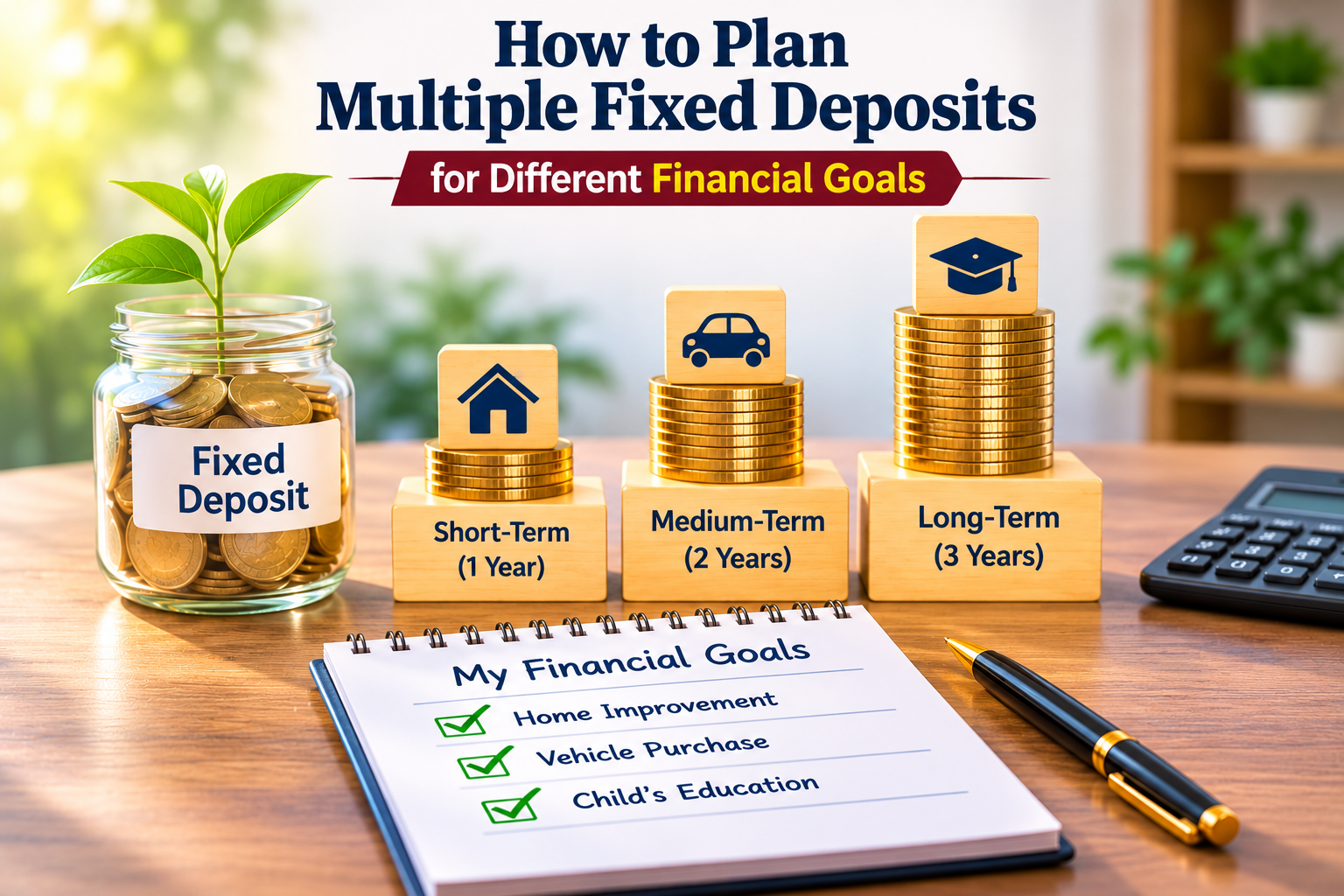
Managing savings becomes easier when every financial goal has a clear purpose and timeline. Some expenses may arise within a year, while others, such as family celebrations, home improvements or future financial commitments, may require several years of preparation.
A Fixed Deposit (FD) allows individuals to set aside a lump sum for a selected period and earn interest according to the applicable scheme conditions. However, placing all available savings into a single Fixed Deposit may not always match different financial needs.
One approach worth understanding is Fixed Deposit laddering, which involves dividing savings into multiple deposits with different maturity dates.
This strategy can help individuals organise their savings according to planned expenses while maintaining greater flexibility over when their deposits mature.
What Is Fixed Deposit Laddering?
Fixed Deposit laddering is a savings strategy in which an individual opens multiple Fixed Deposits with different tenures instead of investing the entire amount in one deposit.
For example, someone with ₹1,50,000 available for deposit may consider dividing it into three separate FDs:
-
₹50,000 for a one-year tenure
-
₹50,000 for a two-year tenure
-
₹50,000 for a three-year tenure
This creates three different maturity dates.
Instead of waiting for a single deposit to mature, the individual has scheduled opportunities to review and access funds as each FD reaches maturity.
The actual maturity amounts depend on the applicable interest rates, payout options and scheme conditions.
Why Consider Multiple Fixed Deposits?
Different financial goals often have different timelines.
A person may want to save for a family function next year while also preparing for home improvements or another expense several years later.
Opening separate Fixed Deposits can help align savings with these different requirements.
1. Plan Savings Around Specific Goals
When each deposit has a defined purpose, it becomes easier to track financial progress.
For example, one FD may be allocated towards an upcoming household expense, while another may be intended for a longer-term financial commitment.
2. Create Different Maturity Dates
Multiple maturity dates allow individuals to review their financial position at different intervals.
This can be useful when expenses are expected at different stages.
3. Reduce the Need to Break One Large Deposit
If all savings are placed in one FD, accessing a portion before maturity may require premature or partial withdrawal, depending on the scheme.
Separate deposits may reduce the need to disturb longer-term savings when a shorter-term deposit matures.
4. Review Interest Rates at Different Times
As deposits mature, individuals can review the interest rates and financial products available at that time.
However, future interest rates are uncertain, and reinvesting at maturity may produce higher or lower returns.
How to Plan Fixed Deposits for Different Financial Goals
A practical FD strategy begins with identifying your financial priorities.
Step 1: List Your Upcoming Financial Requirements
Start by writing down expenses you expect over the next few years.
These may include:
-
Household improvements
-
Family celebrations
-
Education-related expenses
-
Vehicle-related expenses
-
Planned purchases
-
Other financial commitments
Estimate the amount required and the approximate date when you may need the funds.
Step 2: Categorise Your Goals by Timeline
Group your financial goals into short-, medium- and longer-term requirements.
For example:
| Financial Goal | Expected Timeline | Planning Approach |
|---|---|---|
| Household purchase | 1 year | Shorter-tenure FD |
| Home improvements | 2 years | Medium-tenure FD |
| Family celebration | 3 years | Longer-tenure FD |
This is an illustrative example, not a recommendation to invest specific amounts or select particular products.
The available tenure options should always be checked before opening a deposit.
Step 3: Decide How Much to Allocate
Once you identify your goals, determine how much of your savings can be committed to Fixed Deposits.
Avoid depositing money needed for everyday expenses or unexpected emergencies.
Maintaining a separate emergency fund can help reduce the need for premature withdrawal.
Step 4: Compare Available Deposit Tenures
Different tenures may offer different interest rates and maturity outcomes.
Before selecting a deposit, compare the applicable rates, interest calculation methods and payout conditions.
Pride Credit Society offers multiple Fixed Deposit tenure options, subject to the society's current scheme terms.
Members can review the available options on the Pride Credit Society Fixed Deposit page.
Step 5: Maintain a Record of Maturity Dates
When managing several deposits, keeping track of maturity dates becomes important.
A simple spreadsheet or financial notebook can help you record:
-
Deposit amount
-
Deposit opening date
-
Selected tenure
-
Applicable interest rate
-
Interest payout option
-
Expected maturity date
-
Financial goal linked to the deposit
This makes it easier to review your savings plan periodically.
Example: Planning ₹2 Lakh Across Multiple Fixed Deposits
Suppose an individual has ₹2,00,000 available after setting aside sufficient emergency savings.
Instead of placing the entire amount into one Fixed Deposit, they may consider the following illustrative allocation:
| Deposit | Amount | Tenure | Purpose |
|---|---|---|---|
| FD 1 | ₹40,000 | 1 year | Planned household expense |
| FD 2 | ₹60,000 | 2 years | Home improvements |
| FD 3 | ₹1,00,000 | 3 years | Future family commitment |
| Total | ₹2,00,000 |
This arrangement creates separate maturity dates that can correspond with different financial goals.
The illustration does not include interest calculations, taxes or charges. Actual returns depend on the institution's applicable terms.
Is FD Laddering Better Than Opening One Fixed Deposit?
There is no single approach that works for everyone.
Opening one FD may be simpler for someone who has one clearly defined financial goal and does not expect to need the money earlier.
Multiple FDs may be more convenient for someone managing several expenses across different years.
The decision should consider:
-
The number of financial goals
-
When the money will be needed
-
Available deposit tenures
-
Interest rates and calculation methods
-
Premature withdrawal conditions
-
Administrative convenience
-
The financial strength of the deposit-taking institution
Splitting money into several deposits with the same institution does not eliminate the risk associated with that institution.
Important Factors to Check Before Opening Multiple FDs
Minimum Deposit Requirements
Every Fixed Deposit scheme may have a minimum opening amount.
Pride Credit Society currently states a minimum Fixed Deposit amount of ₹10,000, subject to applicable conditions.
Premature Withdrawal Rules
Financial circumstances can change.
Before opening multiple deposits, understand whether premature or partial withdrawals are permitted and what deductions or conditions may apply.
Interest Payout Options
Some depositors prefer receiving interest periodically, while others prefer receiving the applicable interest at maturity.
Choose an option that suits your cash-flow needs.
Tax Implications
Interest earned from Fixed Deposits may be taxable under applicable income tax provisions.
Tax treatment and TDS requirements should be considered when estimating returns.
Deposit Safety and Institutional Risk
Before placing funds with a credit co-operative society, understand its regulatory status, financial position and the protections applicable to your deposit.
Deposits with a credit co-operative society should not automatically be assumed to have the same DICGC insurance protection as eligible bank deposits.
Explore Fixed Deposit Options at Pride Credit Society
Pride Credit Society offers Fixed Deposit facilities for eligible active members, with different deposit tenures and interest payout choices.
The society's published FD information includes:
-
A minimum deposit amount of ₹10,000
-
Multiple tenure options
-
Monthly, annual and maturity interest payouts
-
Premature and partial withdrawal facilities subject to society norms
-
Loan facilities against eligible deposits, subject to conditions
-
Mandatory KYC documentation for members
Members can explore the available schemes and review the latest terms through the Fixed Deposit service page.
Before opening a deposit, confirm the current interest rates, applicable tenure options, withdrawal rules, tax implications and associated risks with the nearest Member Service Centre.
Final Thoughts: Give Every Fixed Deposit a Clear Purpose
Financial planning is not only about how much money you save but also about when you will need it.
Dividing savings into multiple Fixed Deposits with different maturity dates can help you organise planned expenses and review your financial decisions at appropriate intervals.
However, FD laddering does not guarantee better returns or remove deposit-related risks. The approach should be considered alongside your liquidity requirements, financial goals and the terms of the deposit scheme.
For eligible members exploring different Fixed Deposit options, Pride Credit Society provides a range of deposit tenures and interest payout choices.
Plan your financial goals thoughtfully and explore the available Fixed Deposit options with Pride Credit Society.

